A necklace is any piece of jewelry worn around the neck: a chain, a strand of pearls or beads, a band of metal with or without gems, or a pendant on a chain. Its length determines where it sits, and the clasp how securely it fastens. This page covers the main types of necklaces, their lengths, what to consider when choosing them, and how to care for them, followed by some history and interesting facts. For the kinds of links a chain can have, see the Chains page. We can make any necklace to order, in gold or platinum, with or without stones or pearls.
Types of necklaces
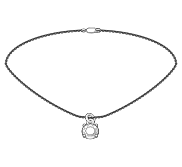
Pendant necklaces
A pendant usually hangs from the chain by a bail, a small metal loop; a slide has no bail and fits directly onto the chain. A diamond solitaire pendant is one of today’s most popular necklaces. More on the Pendants page.
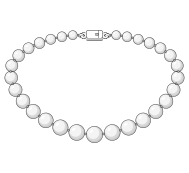
Pearl strands
The pearls can all be nearly the same size, or graduated, with the largest at the center and smaller ones toward the clasp. A pearl strand is a classic that goes with a wide range of outfits.
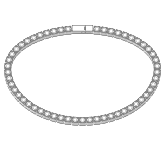
Tennis necklaces
An unbroken line of individually set stones, usually diamonds of the same size. An older form is the rivière (French for river), whose stones can be all the same size or graduated toward the center.
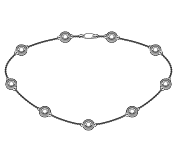
Station necklaces
Gems, pearls, or beads are spaced at regular intervals along a chain, cord, or wire. A classic example is Tiffany’s Diamonds by the Yard.
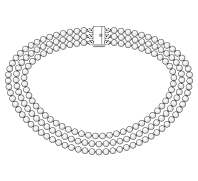
Multi-strand necklaces
Two or more strands or chains, layered or twisted together. You can create a similar look by wearing several chains of different lengths at once.
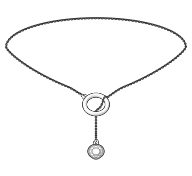
Y-necklaces and lariats
A Y-necklace has a vertical drop at the front, so it forms the letter Y. A lariat is a long necklace, usually without a clasp: you pass one end through a loop at the other or tie the ends together.
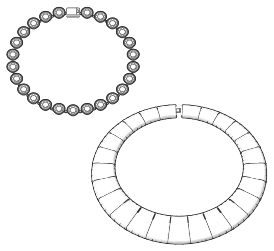
Chokers and collars
A choker is a short necklace that fits closely around the throat. It can be one or more strands of pearls or gems, or a band of metal. A collar is a wide necklace worn around the neck, above the collarbone.
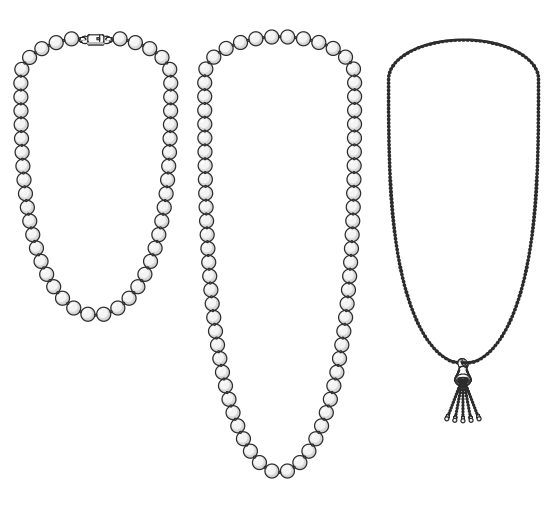
Long necklaces
Necklaces that fall on the chest or lower; the longest can be wrapped around the neck two or more times. A distinctive type is the sautoir: a long necklace, often ending in a tassel or pendant, that was especially popular in the 1910s and 1920s.
Lengths
Chains come in standard lengths of 40, 45, 50, 60, 75, and 90 cm (16, 18, 20, 24, 30, and 36 inches). Exactly where a necklace sits depends on your build. Necklace lengths, especially for pearls, also have names:
- Choker, about 35–40 cm (14–16 in): close to the throat.
- Princess, about 45 cm (18 in): at or just below the collarbone.
- Matinee, 50–60 cm (20–24 in): on the upper chest.
- Opera, 70–90 cm (28–36 in): on the chest or lower.
- Rope, over 90 cm (36 in): the longest; it can be wrapped around the neck two or more times.
The boundaries vary slightly from source to source. If you aren’t sure, use a chain you already own to check where you like a necklace to sit. See also Sizes.
Clasps
Chains usually close with a lobster clasp; fine chains often have a smaller round spring-ring clasp. Pearl strands often have a decorative clasp set with pearls or gems that is an ornament in itself. For all clasp types, see the Clasps and Safety Catches card.
What to consider
The width and thickness of a chain should suit the pendant and its bail. To find out which chains suit a pendant, see the Chains page.
In a pearl strand, the pearls should match in size, shape, luster, surface quality, and color. Knots between the pearls keep them from rubbing against each other and damaging the nacre.
Care
Store necklaces separately, ideally each in its own compartment or pouch, so they don’t tangle or scratch. At the annual inspection, we check the clasp, the pendant’s bail, and the stones.
Put on a pearl necklace only after you have applied makeup and styled your hair, and wipe it with a soft, clean cloth after wearing. Store it apart from other jewelry, in a soft pouch. Never clean pearls ultrasonically or with steam or ammonia.
If you wear a pearl strand often, have it restrung about once a year or when the thread shows wear. If you wash it in warm, mild soapy water, let it dry before wearing it again, as wet thread can stretch and attract dirt.
History
Necklaces are among the oldest ornaments. In Blombos Cave in South Africa, archaeologists found perforated shells of tiny sea snails, about 75,000 years old, that were probably strung as beads. In burial mounds in what is now Ohio, archaeologists found necklaces of beads and natural freshwater pearls about 2,000 years old.
Around 1900, chokers were in fashion. They were popularized by Queen Alexandra, wife of King Edward VII, who first wore one as a princess to cover a small scar on her neck. With the straight, loose-fitting dresses of the 1910s and 1920s came long necklaces called sautoirs, often ropes of pearls ending in a tassel or pendant.
By 1920, Kokichi Mikimoto was marketing cultured pearls internationally. In the mid- to late 1940s, American soldiers bought large numbers of cultured pearl necklaces to take home to their wives and sweethearts, an important step in making cultured pearls popular in the US.
Did you know?
A mansion for a pearl necklace. In 1917, Pierre Cartier acquired the Fifth Avenue mansion in New York that still houses Cartier in exchange for a double-strand natural pearl necklace, then valued at about $1 million. Soon afterward, cultured pearls took hold and natural pearl prices collapsed: when the necklace was auctioned in 1957, it brought less than $200,000.
The necklace that harmed a queen. The Paris jewelers Böhmer and Bassenge made a lavish diamond necklace that they could not sell. In 1785, the Countess de La Motte used forged letters to convince Cardinal de Rohan that he was buying it on behalf of Queen Marie Antoinette; the swindlers then broke it up and sold the diamonds, mostly in London. The queen knew nothing of the fraud, but the scandal badly damaged her reputation only a few years before the French Revolution.
Twenty-five years for one strand. Gathering enough natural freshwater pearls for a single graduated strand took more than 25 years. In the US, such pearls are sometimes found in freshwater mussels harvested to make bead nuclei for cultured pearls.
Pearls that float. When the pearls are spaced along fine, nearly invisible nylon instead of silk thread, they seem to float with no support. Such a necklace is called a floater.
How we work
We design every necklace individually, adapting the length, the chain, and the clasp to you, to the pendant or stones, and to how you will wear it. When we design a necklace in 3D, we show you the model before we make it, so you can see it from every side. We select the pearls or stones for a necklace so that they match. We can also shorten or lengthen a necklace you already own, replace its clasp with a new or more secure one, and restring a pearl necklace with knots between the pearls.